


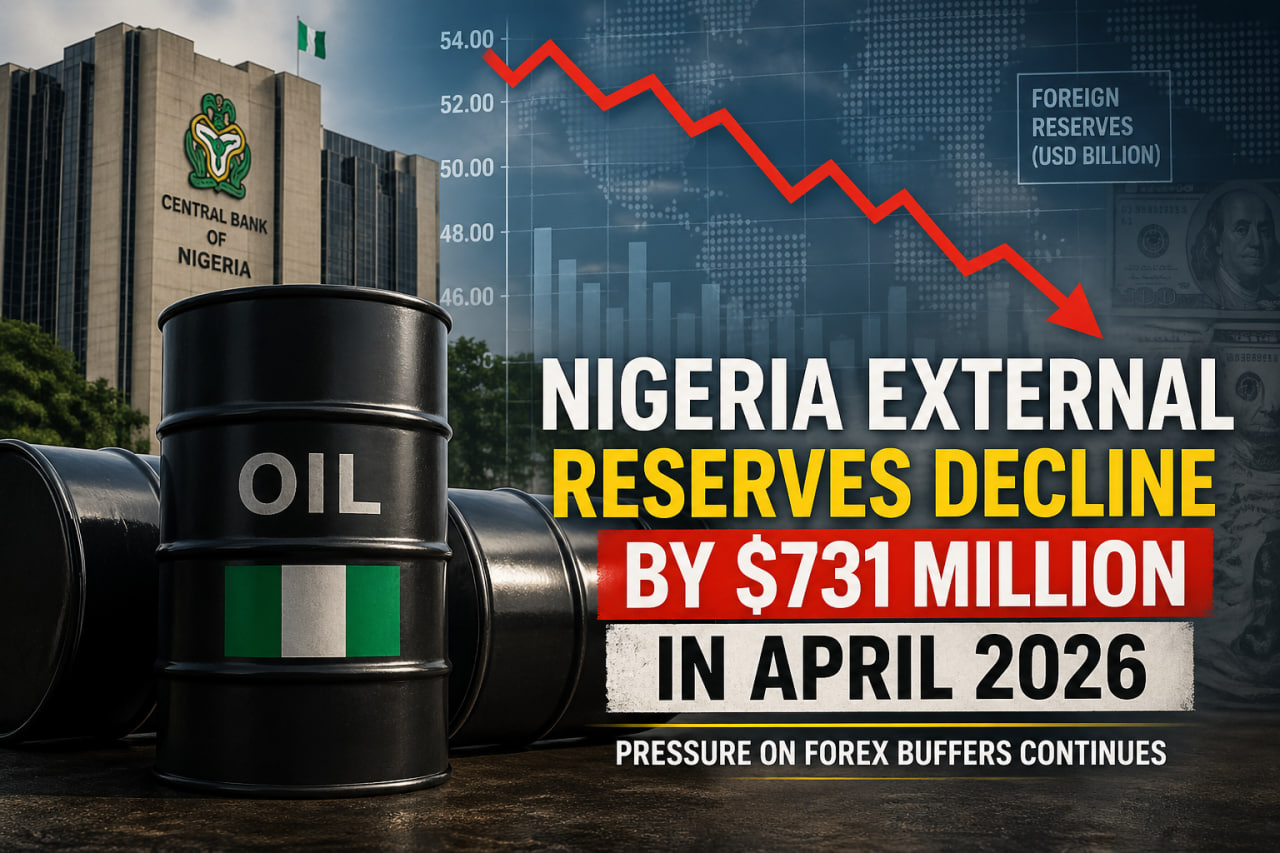
Nigeria external reserves fall by 731 million dollars in April 2026 as pressure on forex buffers continues
Nigeria external reserves decline became evident in April 2026 as the country’s foreign exchange buffers dropped by $731 million within the first three weeks of the month. This development reflects sustained pressure on the nation’s external liquidity position and highlights the balancing act faced by monetary authorities.
Data released by the Central Bank of Nigeria shows that reserves fell from $49.18 billion on April 1 to $48.45 billion by April 23. This represents an average weekly decline of roughly $233 million. The movement continues a broader pattern of drawdowns seen in recent months.
Nigeria External Reserves Decline and April Trend Breakdown
A closer look at the data reveals that the Nigeria external reserves decline was more pronounced at the beginning of April before easing later in the month. This pattern suggests changing dynamics in foreign exchange management and inflow levels.
Between April 1 and April 10, reserves dropped sharply from $49.18 billion to $48.81 billion. This phase likely reflected stronger foreign exchange interventions and the settlement of external obligations.
From April 13 to April 17, reserves declined more gradually from $48.72 billion to $48.62 billion. The pace slowed further between April 20 and April 23, when reserves dipped slightly from $48.54 billion to $48.45 billion.
This moderation may indicate reduced intervention intensity or improved inflow support. Institutions like the International Monetary Fund often note that such short term reserve movements are influenced by policy responses and market conditions.
Nigeria External Reserves Decline in Context of Recent Months
The Nigeria external reserves decline in April follows similar pressure recorded in March 2026. During that period, reserves fell from over $50.08 billion on March 12 to $49.61 billion by March 23.
Despite this recent trend, current reserve levels remain significantly higher than the same period in 2025, when reserves stood at about $37.83 billion. This indicates that while there is short term pressure, the broader position is still relatively stronger.
Earlier in January 2026, reserves had increased by about $509 million within the first 22 days, pointing to improved inflows at the time. The April figures therefore represent a reversal of that earlier upward movement.
Historical patterns also show that such fluctuations are not unusual. In October 2018, reserves declined by $1.1 billion within two weeks, demonstrating that short term volatility has long been part of Nigeria’s external sector dynamics.
Key Drivers
Several factors contribute to the Nigeria external reserves decline. These include changes in oil revenue, foreign exchange interventions by the central bank, and the need to meet external obligations.
Nigeria’s dependence on crude oil earnings makes reserves sensitive to global oil price movements. Disruptions in supply chains or geopolitical tensions can affect inflows and, in turn, reserve levels.
Foreign exchange interventions also play a role. The central bank often supplies dollars to stabilize the naira and manage liquidity. While this supports exchange rate stability, it can lead to temporary drawdowns in reserves.
External debt servicing and other international commitments further add to the pressure. According to insights from the World Bank, maintaining adequate reserves is essential for economic resilience and investor confidence.
READ ALSO: Cyber Security Importance in Today’s World
Policy Outlook
Before recent reforms under Bola Tinubu, Nigeria operated a tightly controlled foreign exchange system with multiple exchange rate windows. The central bank played a dominant role in supplying foreign currency and managing the market.
Despite the current Nigeria external reserves decline, the Central Bank of Nigeria remains optimistic about the outlook. The bank has previously projected that reserves could reach $51 billion by the end of 2026.
This projection forms part of a broader strategy aimed at strengthening macroeconomic stability and restoring investor confidence. Efforts are focused on improving inflows, managing outflows, and enhancing overall balance of payments resilience.
CBN Governor Olayemi Cardoso has also stated that the recent decline should not be a cause for concern, suggesting that authorities view the movement as manageable within the current policy framework.
Nigeria External Reserves Decline and What It Means
The Nigeria external reserves decline highlights the ongoing challenges of managing a complex and evolving economic environment. While short term fluctuations are expected, the key concern lies in sustaining adequate reserve levels over time.
For businesses and investors, reserve trends are an important indicator of economic stability. Strong reserves support currency confidence and reduce vulnerability to external shocks.
In the coming months, attention will remain on how effectively Nigeria balances exchange rate stability, liquidity management, and external commitments. The ability to reverse the current trend will depend on improved inflows, stable oil revenues, and consistent policy implementation.
About The Author







1 thought on “Nigeria External Reserves Decline by $731 Million in April 2026”