


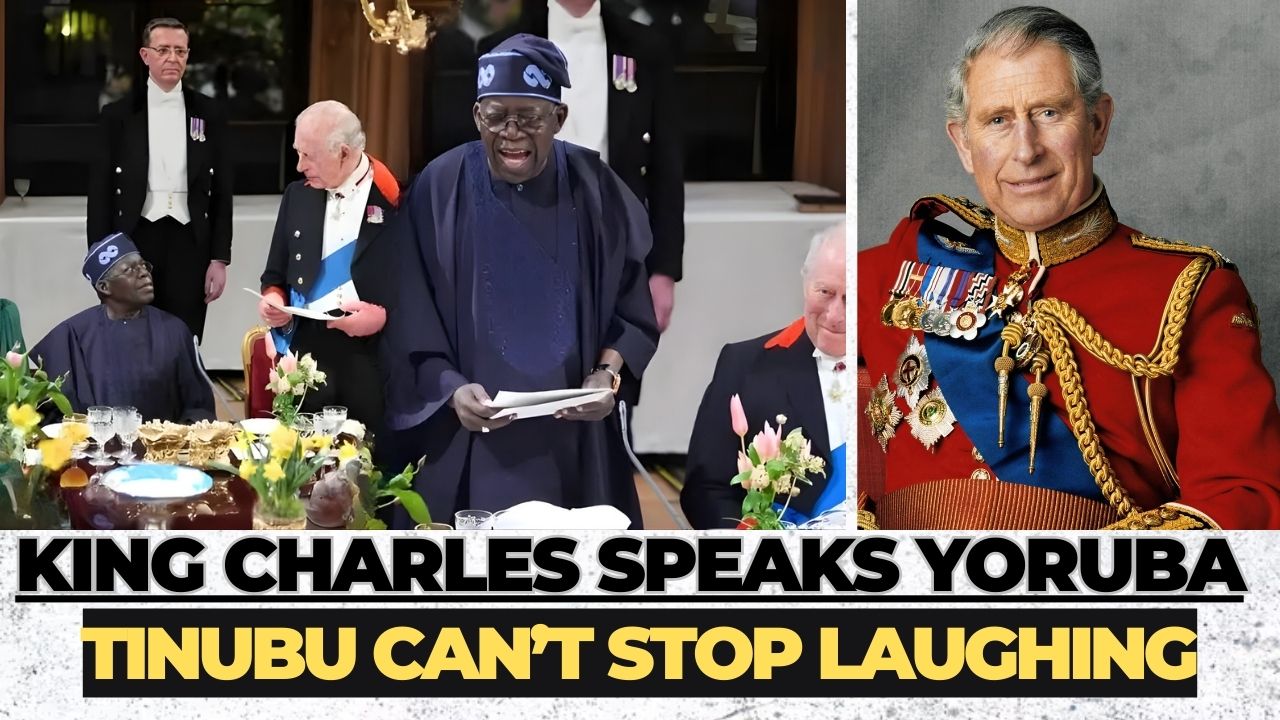
King Charles III delighted guests at a state banquet in Windsor Castle after incorporating several Nigerian languages into his remarks while hosting Bola Tinubu and other dignitaries.
He began with a Yoruba greeting, warmly welcoming attendees, before weaving in cultural references that included a Yoruba proverb on unity, an Igbo saying about knowledge, and a Hausa expression reflecting change.
The multilingual delivery drew laughter and applause, highlighting a moment of cultural connection during the formal event.
The King concluded his speech with a lively phrase in Nigerian Pidgin, “Naija No Dey Carry Last,” prompting an enthusiastic reaction from the audience.
The banquet formed part of Nigeria’s state visit to the United Kingdom, the first of its kind in nearly four decades.
During his address, King Charles also acknowledged Nigeria’s growing global presence, describing it as a major economic and cultural force while reflecting on the longstanding relationship between both countries.
About The Author





Beyond Ceremony: What Tinubu’s UK Visit Must Mean for Nigeria.
By Osmen Center for Constructive Alternatives.
(Ideas Have Consequences)
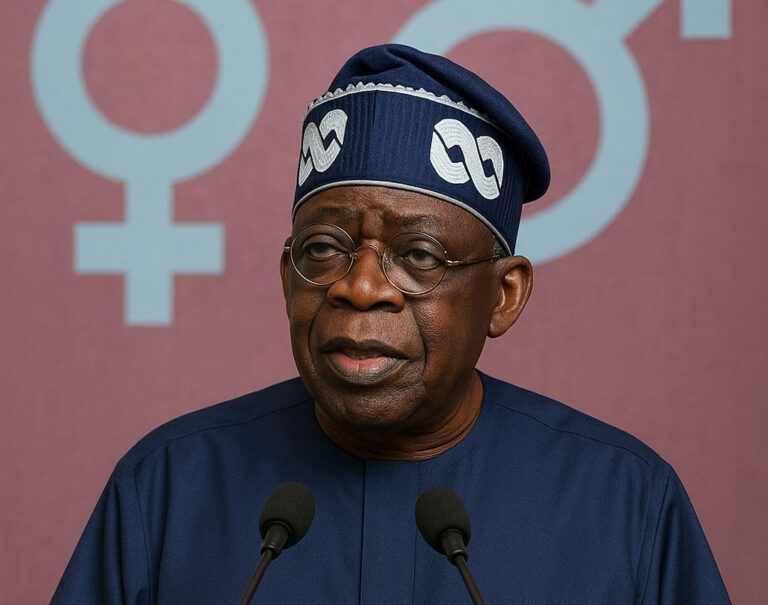
The recent State Visit of President Bola Ahmed Tinubu to the United Kingdom is, without doubt, a moment of diplomatic prestige. It reflects a long-standing relationship between Nigeria and the UK—one rooted in history but increasingly shaped by trade, security cooperation, and shared global interests.
Yet, beyond the ceremonial grandeur lies a more pressing question: What does this visit truly mean for Nigeria’s future?
Diplomatically, the visit sends a strong signal. Nigeria remains a key player in Africa and an attractive partner in a post-Brexit global economy. Economically, frameworks such as the Enhanced Trade and Investment Partnership (ETIP) present opportunities for growth across sectors—energy, agriculture, technology, and the creative industries.
However, the fundamental challenge remains unchanged: Nigeria’s internal contradictions.
A nation battling inflation, insecurity, institutional distrust, and governance deficits cannot rely solely on external validation. The risk is clear—global recognition without domestic transformation.
For decades, Nigeria has entered into bilateral agreements with promising outlooks. Yet, implementation has often faltered. Economic gains rarely trickle down. Structural inefficiencies persist. Public trust continues to erode.
This moment, therefore, demands honesty.
True partnership between Nigeria and the United Kingdom must include candid engagement on governance realities. It is not interference; it is responsible diplomacy. A stable, accountable, and well-governed Nigeria is not only in the interest of its citizens but also in the strategic interest of its global partners.
Nigeria must confront urgent structural questions:
Can democratic legitimacy survive without credible elections?
Can economic reforms succeed without institutional integrity?
Can security improve without systemic overhaul?
Can justice prevail when the judiciary is perceived as compromised?
The erosion of trust in electoral processes and institutions such as the judiciary represents a deeper crisis—one that diplomacy alone cannot fix.
Reform must be deliberate and courageous.
This includes restoring confidence in elections, strengthening institutional independence, rebuilding ethical leadership, and exploring innovative solutions such as secure digital voting systems that reduce manipulation, violence, and voter suppression.
Nigeria’s greatest challenge is not the absence of opportunity, but the absence of structure.
President Tinubu’s UK visit should not be remembered merely as a ceremonial milestone. It must serve as a turning point—a moment that compels Nigeria to align its global ambitions with domestic realities.
Because ultimately, no nation can outsource its stability.
The real work remains at home.
Wow. Thanks for your submission