

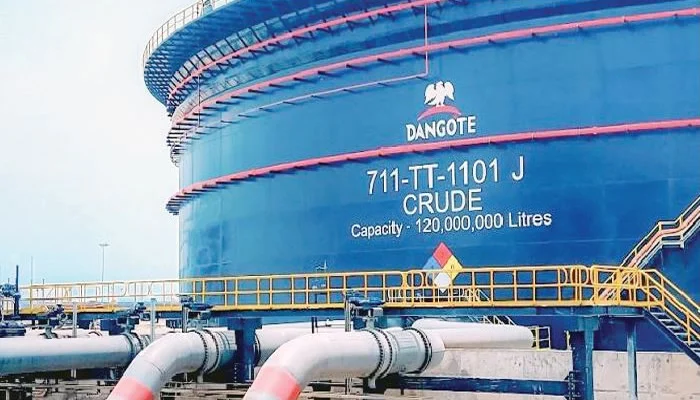
The Dangote Petroleum Refinery in February 2026 supplied roughly 92 per cent of Nigeria’s daily petrol demand, as the Federal Government temporarily halted Premium Motor Spirit (PMS) imports. Despite a N100 reduction in the refinery’s gantry price, petrol continued to sell above N1,200 per litre at filling stations.
Multiple sources at the Nigerian Midstream and Downstream Petroleum Regulatory Authority (NMDPRA) and major fuel importers confirmed that no import licences have been issued this year. Officials noted that domestic refining is sufficient to meet national petrol requirements.
“It’s correct that no import licences have been issued in 2026. Local production now meets the country’s needs, so importation is unnecessary,” a senior NMDPRA source said on condition of anonymity.
According to the NMDPRA February 2026 fact sheet, local refineries supplied 36.5 million litres per day of petrol, while imports contributed just three million litres daily, bringing total supply to 39.5 million litres. This represents a sharp departure from Nigeria’s historical reliance on imported fuel. Currently, the Dangote refinery is the sole producer of petrol, as other modular refineries primarily focus on diesel production.
By contrast, in January 2026, domestic refineries supplied 40.1 million litres per day, with imports averaging 24.8 million litres daily, for a total of 64.9 million litres. The February decline reflects the drop in imports, which NMDPRA quantified as a 25.4 million litre-per-day reduction.
Historically, imports have supplied a significant share of the market. In December 2025, for instance, imported petrol averaged 42.2 million litres per day, while domestic refineries contributed 32.0 million litres. Earlier in 2025, total daily supply fluctuated between 43.7 million litres in January and 57.1 million litres in May, with local refining accounting for only 32 to 47 per cent of supply.
The Dangote refinery’s capacity expansion and consistent production have now shifted market dynamics. At full capacity of 650,000 barrels per day, it supplies over 50 million litres of petrol daily, reducing dependence on imports and reshaping the downstream sector. Some industry operators, however, raised concerns about potential monopolistic tendencies and higher domestic prices compared with imported fuel.
Fuel Prices Remain Elevated Despite Gantry Reduction
On Tuesday, the Dangote refinery lowered its gantry price by N100 to N1,075 per litre, yet petrol prices at retail outlets remained largely unchanged. Surveys in Lagos, Ogun, and Abuja found petrol selling between N1,200 and N1,330 per litre, with some stations recording rates as high as N1,330 per litre.
The price adjustment followed a drop in Brent crude below $90 per barrel, down from over $100 earlier that Monday. The refinery attributed previous price hikes to global oil market volatility driven by tensions in the Middle East. It has also emphasized that its pricing remains tied to international benchmarks, with no subsidies applied to crude or foreign exchange.
The refinery stated, “We believe it is imperative to reduce prices as a reflection of the decline in global crude oil prices. All our crudes are priced on the global benchmark plus a $3–$6 premium and converted at the prevailing naira exchange rate.” It added that past pricing decisions in 2025 reflected a commitment to balancing economic realities with national energy security.
Global Oil Market Context
Oil prices have recently experienced high volatility. Brent futures dropped nearly 27 per cent from a previous high of $119 per barrel to $87 per barrel, while US West Texas Intermediate fell 12.9 per cent to $82.53 per barrel. Prices had surged earlier due to production cuts by Saudi Arabia and other countries amid fears of Middle East disruptions, prompting temporary increases in local petrol prices.
Internationally, the International Energy Agency (IEA) reported that G7 energy ministers are closely monitoring oil market conditions, emphasizing emergency stock releases and contingency planning to mitigate supply risks. IEA members hold over 1.2 billion barrels of public emergency oil stocks, with an additional 600 million barrels under government obligations in industry storage.
Outlook
With the Dangote refinery now producing the bulk of Nigeria’s petrol, import dependence has dropped sharply. February 2026 saw imports decline from 24.8 million litres per day in January to just three million litres daily—a decrease of nearly 88 per cent. While this strengthens domestic refining capacity, experts caution that sustained market dominance could lead to higher prices if competition is insufficient.
About The Author